


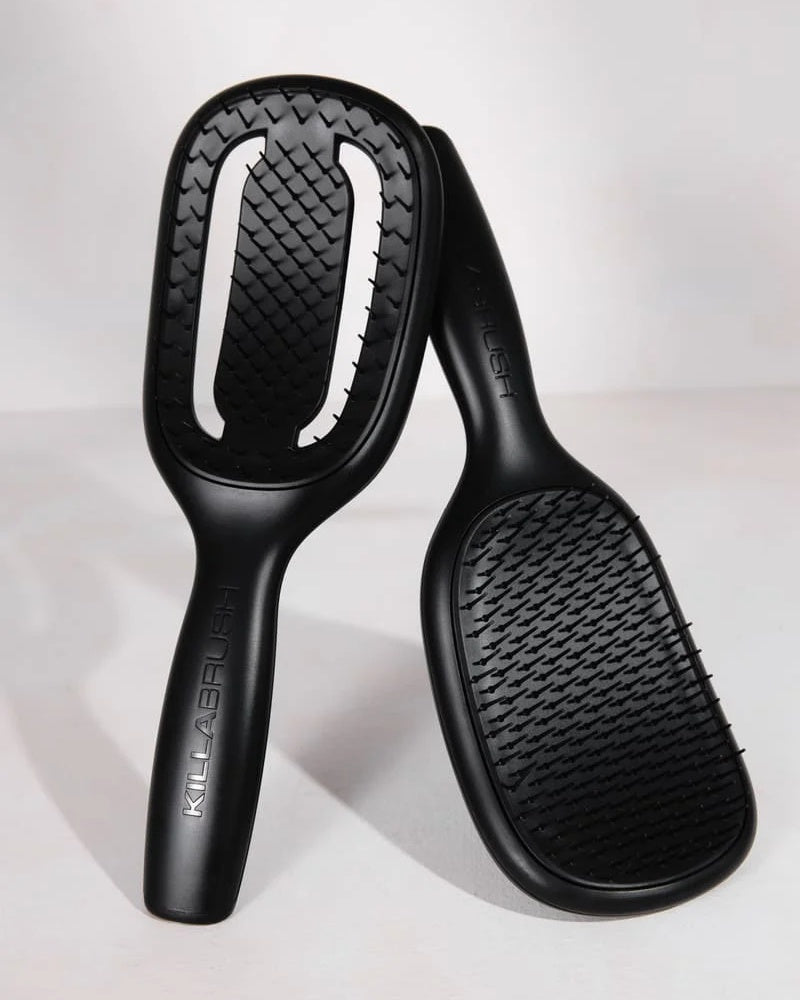
A paddle brush is flat and wide, built for detangling and smoothing longer or thicker hair. A round brush wraps hair around a barrel to create volume and curve while blow-drying. A vent brush has airflow channels that cut rough-drying time. Many modern brushes combine two of the three.
Most people own the wrong brush for what they actually do with it — usually because brushes get bought on looks and price rather than function. Here's what each type is genuinely for, and an honest answer on which you need (which may be fewer than you think).
| Paddle | Round | Vent | |
|---|---|---|---|
| Shape | Flat, wide head | Cylindrical barrel | Flat or curved, open channels through the body |
| Built for | Detangling, smoothing, everyday brushing | Volume, curve and bend during blow-drying | Faster rough-drying with a dryer |
| Best hair types | Medium to long, thick, straight-to-wavy | Any hair being styled with heat | Anyone who blow-dries; fine hair that needs body |
| Blow-dry role | Smooth, straight results over large sections | Shaped, voluminous results in small sections | Speed — air reaches both sides of the section |
| Skill needed | None | Moderate (sectioning, tension, technique) | None |
| Between-use drying | Slower if solid-backed | Slow (dense bristle bed) | Fast — air moves through the body |
The paddle brush: the everyday workhorse
The paddle's flat, wide head covers a lot of hair per stroke, which is what makes it the default for detangling and daily brushing on medium-to-long hair. The cushioned base flexes over the scalp's contours, so tension stays even and comfortable — including over a sensitive scalp. If you own one brush, this is usually the one. Full buying guidance in our paddle hair brush collection.
The round brush: a styling tool, not a daily brush
An honest note, since we don't sell one: a round brush is the right tool for a specific job — creating volume at the root and bend or curl through the lengths during a sectioned blow-dry. If salon-style bounce is your goal, buy a round brush and learn the technique; nothing else replicates it. But it's a poor daily detangler (the barrel grabs), and for smooth, straight blow-dry results a paddle does the job with far less skill. Most people who own a round brush use it four times and then need what they should have bought first.
The vent brush: the speed (and hygiene) play
Vents exist for airflow. Open channels through the brush body let dryer air pass straight through to the hair on both sides of each section instead of being blocked by a solid back — fewer passes, less heat exposure, faster drying. That's the headline benefit. The quieter one: a body that air moves through also dries out quickly between uses, and a brush that spends less time damp accumulates less of the buildup every brush collects.
Or two of the three at once
The types aren't mutually exclusive — the shape and the airflow are separate design choices. A vented paddle brush gives you the flat coverage and everyday usability of a paddle with the drying speed of a vent brush, which is precisely the combination KILLABRUSH builds: see the vented hair brush collection. Whatever the shape, every KILLABRUSH carries the same antimicrobial technology, clinically tested to eliminate up to 99.9% of surface bacteria on the brush.
The cross-cutting factor: whatever you choose, keep it clean
Shape determines what a brush does to your hair; hygiene determines what it deposits on it. Every type on this page accumulates the same sebum, skin cells and product residue, and every type needs the same one-to-two-week cleaning schedule — round brushes worst of all, since the dense barrel traps hair and dries slowly. Method for every type: how to clean a hairbrush properly.