


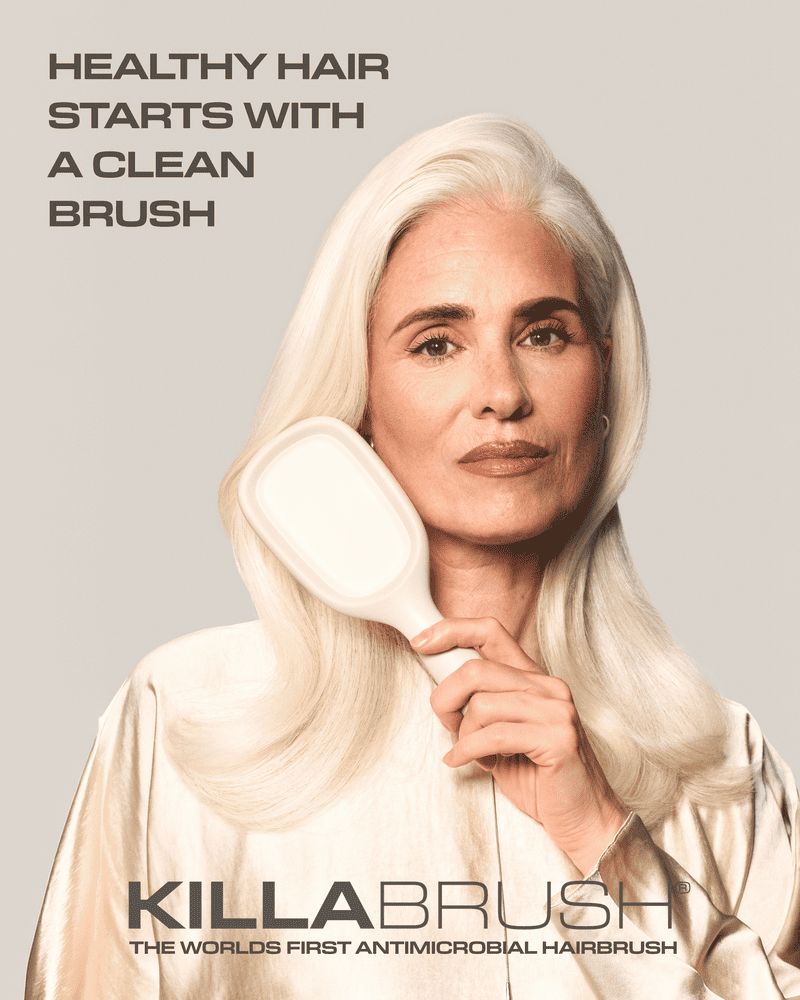
Research swabbing everyday hairbrushes has found an average of around 3,500 bacteria colonies per square inch — a higher count than many bathroom surfaces.
The buildup of shed hair, skin cells, sebum and product residue gives microorganisms an oil-rich surface to persist on between uses.
Here's a comparison to sit with: the object you draw across your scalp and through every strand of your hair, most days of your life, would fail a hygiene inspection that your toilet seat might pass. Not because your bathroom is unusual — because of what a hairbrush is and what nobody does to it.
WHAT THE RESEARCH MEASURED
When researchers swab used hairbrushes and culture they find, brushes accumulate sebum, product residue, skin cells and bacteria (Bacterial Contamination in Cosmetic Brushes, 2025). For context, studies of household objects routinely place unwashed personal-care tools among the most microbial loaded items in the home, ahead of surfaces people actively worry about.
The reason isn't mysterious. A used brush offers everything microorganisms need to persist: moisture (bathroom humidity, brushing damp hair), warmth (ambient room temperature is comfortably within bacterial growth range), and above all food
— sebum, the natural oil your scalp produces, is rich in fatty acids, and it coats the bristles a little more with every stroke. Add dead skin cells, styling product residue and the dust that oily surfaces attract, and the base of your bristles becomes the grey felt you'll recognise from your own brush — a slow-cooked accumulation that a quick rinse never touches.
THE HONEST PART: WHAT "DIRTY" ACTUALLY MEANS
Now the part most articles on this subject skip, and the reason this one exists: the majority of what lives on your hairbrush is your own skin flora — the same community of bacteria and yeasts that lives on your scalp and would be there regardless.
Finding bacteria on a brush is not, by itself, alarming; finding bacteria on any human-adjacent object is a certainty.
The issue is not exotic pathogens. It is accumulation and redeposit. Your scalp continuously manages its own microbial balance; your brush just accumulates, stroke after stroke, week after week, with no immune system and no cleansing routine of its own. Every use is a two-way transfer: the brush takes oil, skin cells and microbes from your hair — and gives a share of its stored collection back. Used on freshly washed hair, a loaded brush partially undoes the wash. Drawn across the hairline
daily, it adds oil and residue to skin that breaks out when congested — we cover the spots, dandruff and greasy-hair questions in detail here.
That's the accurate picture: not a horror story, a hygiene gap. The brush is the only tool that touches your scalp and every fibre of your hair daily, and it's the one tool in the bathroom that most people have never once washed.
Want to see how your own brush likely compares? Our interactive DIRTIER? experience puts the numbers side by side with objects you'd never let near your face.
WHAT TO DO ABOUT IT
Two habits close the gap:
Clean on a schedule. Strip trapped hair after every few uses, and deep clean the brush every one to two weeks — the full trichologist-approved method takes five minutes, and the right frequency for your hair type is here.
Start from a cleaner baseline. Cleaning resets the brush; what happens between cleans depends on the tool. The Original Paddle is built with antimicrobial technology engineered into the brush itself — clinically tested to eliminate up to 99.9% of
surface bacteria — so the surface your hair touches stays hygienically cleaner from one wash to the next.
A clean scalp routine deserves a clean tool. Everything else in scalp health builds from there.